We have a new wordpress blog that we will be using from now on:
www.smARThistory.org/blog
Kamis, 06 April 2006
Kamis, 23 Maret 2006

Van Gogh's Starry Night at MoMA
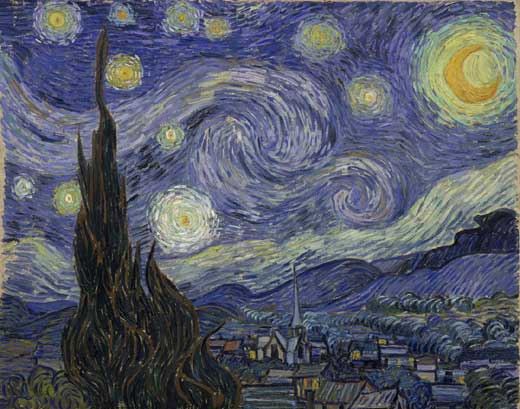
Here are our observations about this famous painting, and the crowds that continually surround it at the Museum of Modern Art.
Jumat, 17 Maret 2006
Goya, Politics and the Power of Images

My online students got into a heated discussion about how Enrico Scrovegni, the patron of Giotto's frescos in the Arena Chapel, asked Giotto to depict him handing the chapel to the angels and Virgin Mary in heaven -- thus implying a kind of virtuousness about himself, that the students felt to be a kind of potentially false representation.
So, we made this vodcast about how images can be used to support specific political agendas, focusing on the famous painting by Goya, The Third of May, 1808.
Warning: There are some difficult images in this video that may not be appropriate for all ages.
This is currently working in internet explorer and firefox but seems to have a so far inexplicable problem in safari.
Click here to watch.
Rabu, 08 Maret 2006
Sick and tired of the silence!

Well, if women have to be naked to get into the Met, what do they have to do to get parity in technology-related work? It seems nothing will work. Pretty much everytime I mention this problem to both male and female colleagues at SUNY -- I am met with an uncomfortable silence, as though they are all sitting there thinking "ugh, here she goes again." Recently two committees were announced up in Albany -- in the Office of SUNY Learning Environments -- regarding the future of the SUNY Learning Network. Now before I write anything else, I want to say that I care deeply about SLN. I am grateful to be part of that community -- colleagues like Michael Feldstein, Patrick Masson, Ken Udas, Rob Piorkowski (and the other MIDs), and Alexandra Pickett (and many others that I am not naming here), make my job so much more interesting and challenging, and they have taught me so much.
Anyway, these two committees -- the Executive Committee (which is about to make some VERY important decisions about the future of SLN) and the Technology subcommittee -- are (approximately) 75% men. I said something about this inequity at a conference call -- and no one -- no one! -- said something that indicated that they were also concerned about the issue. To her credit, Alex told me that she would relay my concerns to the subcomittee, but that's as far as I got.
What's up with that? Why the silence? Whe the defensiveness (sometimes I get "Don't look at me -- I didn't do anything")? All I am asking for is some awareness of the issue and some effort toward affirmative action -- taking conscious steps to fix this serious problem. Just some concern, is that too much to ask? Apparently so.
Rabu, 01 Maret 2006
MemoryMiner
I was reading the kind blog post comments by Suhas Deshpande about our vodcasts, and found another blog entry there (by Corey Timpson) about a program called MemoryMiner. This is a way-cool application for creating storyboards from digital photos by tagging them (or pieces of them), annotating them, dating them, and linking them to a map.
Here is a quote from the website:
MemoryMiner is the first in a series of products by GroupSmarts, a company founded in December 2004 by John C. Fox, a recognized pioneer in the field of networked Digital Asset Management. The central idea behind MemoryMiner is a belief that the most interesting records of modern society and culture exist in analog form, "trapped" in boxes of old photos, letters and the like.
It is clearly intended to be a way to create a history of one's family -- using new and old family photos. The long-term goal is to connect these histories to eachother.
But it seems to me that no one has thought about the enormous academic potential for it.
Think about it -- you could upload images from a period in art history, tag sections of the image (Mary, Christ, St. John, etc.), date the image, annotate the image, attach media files (audio files, vodcasts), connect the image to a geographical location (Florence, Siena, Padua -- you get the idea), then you could sort the images by the tags, and by combinations of the tags -- and what's so cool is this is done graphhically within the program, so if you just want images of Mary, you drag a pic of Mary into the filter area, of if you want images where Christ appears together with St. John, you drag both of them into the filter area. You could follow an artist's oeuvre chronologically the way you follow the life of your grandmother. You could follow iconographic elements within the image.
The thing is, this requires a "skin" in order to take the xml data and images to create a truly inteactive web page. I don't think these skins exist yet. But just think of the authoring possibilities for students and faculty. Wow.
Here is a quote from the website:
MemoryMiner is the first in a series of products by GroupSmarts, a company founded in December 2004 by John C. Fox, a recognized pioneer in the field of networked Digital Asset Management. The central idea behind MemoryMiner is a belief that the most interesting records of modern society and culture exist in analog form, "trapped" in boxes of old photos, letters and the like.
It is clearly intended to be a way to create a history of one's family -- using new and old family photos. The long-term goal is to connect these histories to eachother.
But it seems to me that no one has thought about the enormous academic potential for it.
Think about it -- you could upload images from a period in art history, tag sections of the image (Mary, Christ, St. John, etc.), date the image, annotate the image, attach media files (audio files, vodcasts), connect the image to a geographical location (Florence, Siena, Padua -- you get the idea), then you could sort the images by the tags, and by combinations of the tags -- and what's so cool is this is done graphhically within the program, so if you just want images of Mary, you drag a pic of Mary into the filter area, of if you want images where Christ appears together with St. John, you drag both of them into the filter area. You could follow an artist's oeuvre chronologically the way you follow the life of your grandmother. You could follow iconographic elements within the image.
The thing is, this requires a "skin" in order to take the xml data and images to create a truly inteactive web page. I don't think these skins exist yet. But just think of the authoring possibilities for students and faculty. Wow.
Selasa, 28 Februari 2006
The Chronicle of Higher Education
I was delighted to learn, rather late last night, that smARThistory was mentioned twice in the past two days. It was mentioned in an article in the Chronicle of Higher Education yesterday by David L. Wheeler, titled "It's Not Your Father's Art-History Intro: Professors Talk About How They Are Shaking Up Survey Courses." It is based on pedagogic issues raised at last week's College Art Association annual conference. Susan Ball, CAA's executive director is quoted as are a three other art historian. Then smartest is mentioned,
In a separate session at the meeting -- "Teaching Art History Online"--... Two faculty members at the Fashion Institute of Technology, Beth Harris and Steven Zucker, told about "vodcasts," a solution to the competition between text and images on a computer screen. The two teachers record audio explanations of the artworks that play while the students are looking at the images. Samples can be found at http://www.smarthistory.blogspot.com
The second mention was very generous indeed. It was written by Suhas Deshpande, Technology Assessment Analyst for the Canadian Heritage Information Network, in his blog Technology & Culture he wrote in part:
smARThistory blog: effective podcasting and vodcasting
"Art historians Beth Harris and Steven Zucker have an incredible art history blog that features highly effective podcasts and
vodcasts... Their podcast on Cezanne (Cezanne Still Life at MoMA) is informative and provocative at the same time, owing
to Beth Harris's avowed lack of admiration for Cezanne.... This site is a model for museums and art galleries who would like to use podcasts and vodcasts to feature content from their collections."
Technology & Culture (www.thirdplanet.com) is a terrific edublog that touchs on numerous issues that I find particularly important and is well worth a visit.
In a separate session at the meeting -- "Teaching Art History Online"--... Two faculty members at the Fashion Institute of Technology, Beth Harris and Steven Zucker, told about "vodcasts," a solution to the competition between text and images on a computer screen. The two teachers record audio explanations of the artworks that play while the students are looking at the images. Samples can be found at http://www.smarthistory.blogspot.com
The second mention was very generous indeed. It was written by Suhas Deshpande, Technology Assessment Analyst for the Canadian Heritage Information Network, in his blog Technology & Culture he wrote in part:
smARThistory blog: effective podcasting and vodcasting
"Art historians Beth Harris and Steven Zucker have an incredible art history blog that features highly effective podcasts and
vodcasts... Their podcast on Cezanne (Cezanne Still Life at MoMA) is informative and provocative at the same time, owing
to Beth Harris's avowed lack of admiration for Cezanne.... This site is a model for museums and art galleries who would like to use podcasts and vodcasts to feature content from their collections."
Technology & Culture (www.thirdplanet.com) is a terrific edublog that touchs on numerous issues that I find particularly important and is well worth a visit.
Minggu, 19 Februari 2006
Manet's Olympia: a New Vod-cast
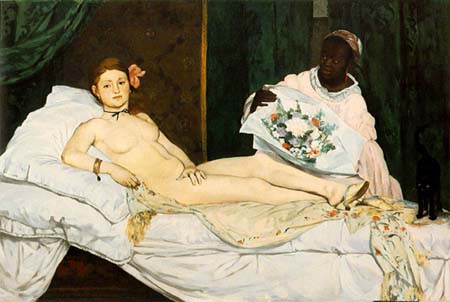
Click here to watch our latest vod-cast about Edouard Manet's famous and scandalous painting, Olympia (1865). It was made with Artstor's Offline Image Viewer and Camtasia.
Sabtu, 11 Februari 2006
My first attempt at a walking tour podcast

Download this podcast to your MP3 player and listen in front of the buildings being discussed. Start at the northwest corner of 6th Avenue and West 10th Street. If possible, listen on a color iPod, that way you also get to see the pictures. If you don’t have one, don’t worry, all you need to do is listen as you stand before the actual buildings.
click here
Kamis, 09 Februari 2006
Febru-wary: Cupertino, Syracuse, Boston
This month is out of control. Last spring Beth and I decided to submit a paper to a panel on online teaching, largely based upon our then upcoming conference, to the College Art Association’s annual extravaganza. CAA is, after all, the single most important annual conference for studio art professors and art historians. Our paper on the digital repository as active learning environment was accepted and all was well. I could, in good conscience certainly leave my graduate contemporary art students and my architecture students to undertake an appropriate assignment for the one class I would miss and I was grateful that my third class, a survey of modern art, is taught entirely online.
What I hadn’t anticipated was that two additional February Wednesdays and Thursdays would also pull me from the classroom. As mentioned in a previous post, our presentation on podcasting was especially well received last December at the SUNY TLT (Teaching and Learning with Technology) conference. Alexandra Pickett, who was in attendance, asked that we deliver that same paper at the MID/AC Summit that she was organizing for mid-February. Since this was scheduled to take place on a day I wasn’t teaching, I agreed. Little did I then know that my spring schedule would be changed. Finally, David Porush Director of Learning Environments and all things related to DL at SUNY announced that he wanted Beth and me to join him and several SUNY colleagues including Michael Feldstein at Apple Computer in Cupertino to meet with their senior VP for education and discuss possible projects. I like to think that our podcasting efforts have finally been recognized by the anointed inhabitants of Silicon Valley, but, in fact, I have no such evidence. Needless to say I said yes even before the date was set. That was a mistake.
The date for the trip to Apple was set without my input and it finally dawned on me that I would be missing three consecutive classes. I have never done that before and take the interests of my students far to seriously to let such a thing happen. I was on the verge of bowing out of at least one of these February jaunts when I finally recognized that the problem was also at least part of the solution.
I will emphatically NOT podcast my lectures. Course-casting seems to me to be by far the least desirable use of podcasting. To simply record an audio or even a video file of a professor chatting away and then foist this upon innocent students seems to me a kind of torture. Lectures may well have some real value in the classroom but to deprive students of the ability to interact is to kill that value. Perhaps there are emergency situations where a course-cast makes sense, Tulane might make a persuasive argument, but being taken out to dinner by Apple doesn’t quaify.
So here is what I’m doing for my History of New York Architecture class. The first week that I am away Dr, Celia Bergoffen, a leading urban archeologist, will teach in my stead. But in the second week, I will have my students download, via Itunes or my website, a series of podcasts that I have already recorded of a multi-part architectural walking tour in the West Village, though I still have to edit the files and upload them. Next week I will be adding an additional segment with Dr. Mathew Postal, a leading architectural historian of New York who works for the Landmarks Preservation Commission. Together we will explore the cast iron district in SoHo. So what will happen, I hope, is that each student will listen to our discussion in front of the building we are discussing thus taking advantage of the ipod’s mobility while giving the students the greater flexibility than a group walking tour affords. To overcome the unidirectional limitation of the podcast, that is, I speak, they listen, I have required that each student take four digital photos while on their private walking tour and that these photos then be uploaded to Flickr where the students are to add indepth annotations and can ask questions. The following week, each is to roam the city and populate our flickr page with buildings and architectural details that they find compelling. I find this a very powerful teaching tool. I get to actually discover not just what, but how the students see. I will thus have a semester’s worth of student-generated material to work with. My fingers are crossed. I’ll let you know how all this goes.
.
This month is out of control. Last spring Beth and I decided to submit a paper to a panel on online teaching, largely based upon our then upcoming conference, to the College Art Association’s annual extravaganza. CAA is, after all, the single most important annual conference for studio art professors and art historians. Our paper on the digital repository as active learning environment was accepted and all was well. I could, in good conscience certainly leave my graduate contemporary art students and my architecture students to undertake an appropriate assignment for the one class I would miss and I was grateful that my third class, a survey of modern art, is taught entirely online.
What I hadn’t anticipated was that two additional February Wednesdays and Thursdays would also pull me from the classroom. As mentioned in a previous post, our presentation on podcasting was especially well received last December at the SUNY TLT (Teaching and Learning with Technology) conference. Alexandra Pickett, who was in attendance, asked that we deliver that same paper at the MID/AC Summit that she was organizing for mid-February. Since this was scheduled to take place on a day I wasn’t teaching, I agreed. Little did I then know that my spring schedule would be changed. Finally, David Porush Director of Learning Environments and all things related to DL at SUNY announced that he wanted Beth and me to join him and several SUNY colleagues including Michael Feldstein at Apple Computer in Cupertino to meet with their senior VP for education and discuss possible projects. I like to think that our podcasting efforts have finally been recognized by the anointed inhabitants of Silicon Valley, but, in fact, I have no such evidence. Needless to say I said yes even before the date was set. That was a mistake.
The date for the trip to Apple was set without my input and it finally dawned on me that I would be missing three consecutive classes. I have never done that before and take the interests of my students far to seriously to let such a thing happen. I was on the verge of bowing out of at least one of these February jaunts when I finally recognized that the problem was also at least part of the solution.
I will emphatically NOT podcast my lectures. Course-casting seems to me to be by far the least desirable use of podcasting. To simply record an audio or even a video file of a professor chatting away and then foist this upon innocent students seems to me a kind of torture. Lectures may well have some real value in the classroom but to deprive students of the ability to interact is to kill that value. Perhaps there are emergency situations where a course-cast makes sense, Tulane might make a persuasive argument, but being taken out to dinner by Apple doesn’t quaify.
So here is what I’m doing for my History of New York Architecture class. The first week that I am away Dr, Celia Bergoffen, a leading urban archeologist, will teach in my stead. But in the second week, I will have my students download, via Itunes or my website, a series of podcasts that I have already recorded of a multi-part architectural walking tour in the West Village, though I still have to edit the files and upload them. Next week I will be adding an additional segment with Dr. Mathew Postal, a leading architectural historian of New York who works for the Landmarks Preservation Commission. Together we will explore the cast iron district in SoHo. So what will happen, I hope, is that each student will listen to our discussion in front of the building we are discussing thus taking advantage of the ipod’s mobility while giving the students the greater flexibility than a group walking tour affords. To overcome the unidirectional limitation of the podcast, that is, I speak, they listen, I have required that each student take four digital photos while on their private walking tour and that these photos then be uploaded to Flickr where the students are to add indepth annotations and can ask questions. The following week, each is to roam the city and populate our flickr page with buildings and architectural details that they find compelling. I find this a very powerful teaching tool. I get to actually discover not just what, but how the students see. I will thus have a semester’s worth of student-generated material to work with. My fingers are crossed. I’ll let you know how all this goes.
.
Senin, 06 Februari 2006
Mary Cassatt's The Cup of Tea

Here's another podcast -- this time about The Cup of Tea (c. 1879)by the American artist Mary Cassatt which is at the Metropolitan Museum of Art. We talk about the freedom of the brushwork and the lack of narrative structure, features which would have disturbed most viewers in the 1880s.
Click here to download or listen with the player below.
Senin, 30 Januari 2006
What do we NEED to learn? And when should we get to learn what we WANT?

Dante Gabriel Rossetti, Dante Meets Beatrice in Heaven, 1852
(an example of what I wasn't allowed to study)
Here are some thoughts and questions that have come up in conversations with colleagues:
____________________
What happens if we course-cast and students stop going to class? Why is that necessarily a bad thing (especially if "class" is a lecture in a large lecture hall filled with students passively listenting)? Maybe it will force teachers to be better teachers -- teachers that make their students want to come to class. Perhaps this is yet another way that teachers will become more accountable to their students.
______________________
From: The iPod Took My Seat - Los Angeles Times: "teaching experts say Internet-era instructors have to change tactics to combat in-class boredom and absenteeism. [one instructor] said he is working to enliven his lectures with material and interaction that students can't get on the audio or video 'coursecasts'; he wants to move to a Socratic teaching method and foster more discussion, while using technology to relay more of the basic information."
___________________________
And here's George Siemens's comment on the article above -- fearless about the loss of student attendence:
George Siemens: "Personally, I don't equate attendance with learning. By now, it should almost be a requirement that course content should be available online - I don't book with hotels or airlines that don't offer online self-service (not sure if there are too many out there that don't have this option). Why would I take a course where online content and discussions aren't available? And if resources are available online, what does the classroom offer that can't be found online? I could see labs and practical demonstrations, some case studies, group simulations requiring attendance. Beyond that, most of what happens in a university lecture is equal to watching a video recording. The only negative I see: sometimes classroom schedules can keep students motivated and on task (so they don't get too far behind)."
_____________________________
I have to say I agree -- why would I take a course without online content, when others offer me that benefit? But is it true that a video of a lecture is equal to sitting in class? Surely this is only true for large lecture courses with a hundred students or so -- surely a classroom run by a teacher who makes her class interactive offers more. Right?
And isn't course-casting just using a new medium (well, new in that it is cheap, easy to use and mobile)to do the same old thing? What can we do with pod-casting that would re-think how we teach?
And again -- back to the theme of my last post -- what will learning look like in the future? If students have more control of their learning, they will choose what they want to study.
[Boy, would I have liked that. I was definitely the square peg in a round hole as both a graduate and undergraduate student in the US (in London, my Masters degree was very specialized and I was oh so much happier). I always wanted to study topics that were not in the canon of art history, and I wanted to approach the material from an interdisciplinary perspective. This was simply unheard of, and I was finally "allowed" to do it only in the most limited way. Who knows what direction my studies would have taken if these inclinations were indulged. And I see it with my daughter too, in fifth grade. Here's someone who already has interests and inclinations, but there is nothing really in the curriculum to nourish those interests.]
On the other hand, perhaps not all students can or should be allowed to choose all their own courses, or perhaps only at a certain age, and after a certain amount of education? Maybe we still need a "core curriculum" so we can turn out citizens who are critical thinkers. So, is the core curriculum absolutely necessary for everyone -- and must it be the same for virtually all students? If students are given their choice of what to study, will they only choose what they know, and not challenge themselves to think critically.
_____________________
Below is a passage from David Warlick's blog that is close to what I have been envisaging. What if we required only a "shallow" core curriculum and then let students take more control of their own learning (with the guidance of an instructor of course). Warlick also emphasizes (quite rightly I think) the uniformity of what we do:
From Two Cents Worth "This is why I believe that our standards should be made much more shallow. Schooling should be responsible for assure that every student knows only that knowledge and those skills that create a productive context for the lives of all students. As a society, we must have a common sense of where, when, what, how, and why we live; and how our environment affects us and how we affect our environment. Schooling should also assure that each student has the basic literacy skills appropriate to the contemporary information environment.
Students should spend a predominant amount of their time making themselves experts in areas of knowledge and experience that are especially interesting to them, and then sharing their gained knowledge and experience with other students. We go from a curriculum model that looks like a hall way that students move down, being saturated by a robust set of knowledge array of disciplines, with little integration of subject areas..to a curriculum model that that looks more like a sphere with the student in the middle."
Rabu, 04 Januari 2006
The University of the Future
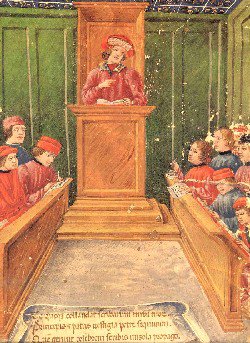
I am reading Euclid's Window: The Story of Geometry from Parallel Lines to Hyperspace, by Leonard Mlodinow (2001). In a chapter entitled "The Legacy of the Rotten Romans," Mlodinow writes about Charlemagne attempting to revive the intellectual tradition of the Ancient Greeks and Romans, and then moves on through the middle ages, discussing the first universities.
What struck me was this description of a 14th century university:
"The concept of a college campus did not yet exist. Typically, a university had no buildings at all. Students lived in cooperative housing. Professors lectured in rented rooms, rooming houses, churches, even brothels. The classrooms, like the dwellings, were poorly lit and heated. Some universities employed a system that sounds, well, medieval: professors were paid directly by the students. At Bologna, students hired and fired professors, fined them for unexcused absence or tardiness, or for not answering difficult questions. If the lecture was not interesting, going to slow, too fast, or simply not loud enough, they would jeer or throw things."
Perhaps this is not so medieval after all -- perhaps it gives us a sense of the university to come? Will the campus exist? In what form? Will the results of websites like "ratemyprofessors.com" be that we will be as accountable to our students as the medieval professor? Will their relationship to us be more direct? Less mediated by an academic administration? As life-long learners, will students pick and choose more freely from an academic menu of sorts -- to attain the skills and knowledge they are looking for? One online course here, another there... Perhaps instructors should be fined by their students for being boring, late or not answering questions! This model implies that students will tell us what they need to learn, instead of vice-versa. Hmmm....
Langganan:
Postingan (Atom)
